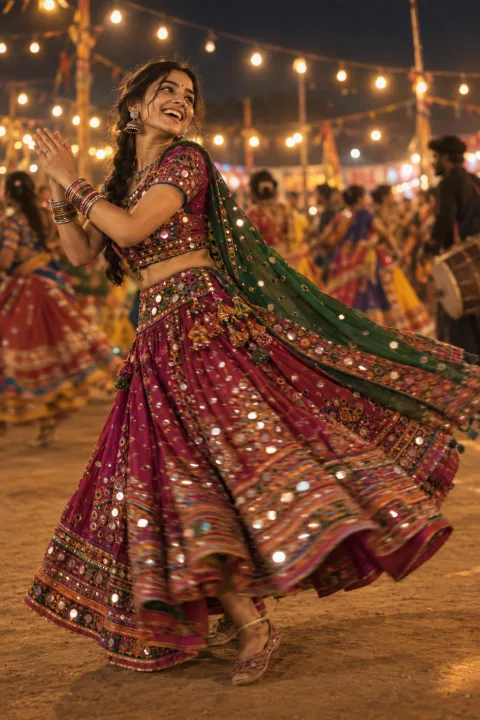

Garba night in a mirror-work chaniya choli
Works with your photo
The picture beside a prompt is what that prompt produced. Each one states the model it was tested on, the ratio it expects, and whether it can keep your own face from a photo.
Prompts for still images, each one shown with the output it produced and the model it was tested on.
26 categoriesPrompts for video models, with the clip each one produced and the settings it needs.
12 categoriesPrompts for work: search, advertising, writing, analysis and code, each written to return something usable rather than a draft.
16 categoriesPrompts for the things that come up every week: replies, messages, notes and planning.
14 categoriesWorks with your photo


Works with your photo
Works with your photo
Works with your photo

Works with your photo
Works with your photo
Every prompt shows the output it produced, so you are choosing a result rather than guessing from a description.
The model it was tested on, the ratio it expects, and whether it works with a photo of your own. Those three explain almost every case where a prompt does not reproduce.
The copy action hands over Markdown with each part under its own heading, so you can change the wardrobe without touching the lighting.
Strong at following a long instruction literally and at legible text in an image.
OpenAIBuilt for editing an existing image and for holding a face across edits.
GoogleGeneral image generation inside a general assistant, useful for quick iterations.
GoogleThe most art-directed look of the group, at the cost of literal instruction following.
MidjourneyThe picture beside a prompt is what that prompt produced. You are choosing a result, not guessing from a description of one.
The same text on two models is two different pictures. A prompt that does not say which one it was run on cannot be reproduced.
Aspect ratio changes what the model puts in frame, not just where it crops. It belongs where you can read it, not buried in prose.
Some prompts only work with a photograph of your own. That is marked on the card, before you copy anything.
Worth having ready about 6 weeks ahead, so the page is indexed before anyone starts looking.
MarchWorth having ready about 6 weeks ahead, so the page is indexed before anyone starts looking.
variesWorth having ready about 6 weeks ahead, so the page is indexed before anyone starts looking.
September or OctoberWorth having ready about 6 weeks ahead, so the page is indexed before anyone starts looking.
Every entry says what the tool does, what it costs, what it is genuinely good at, and where it falls short. Written to one shape, so two tools can be compared without reading two different kinds of page.
Open the directoryTraditional wear, devotional settings and warm light, for the run-up to a festival rather than the morning of it.
Everything that takes a reference photograph and holds the face through it, with what a usable source photo looks like.
Product shots, brand imagery and the listing copy around them, for a shop page or a marketplace listing.
Festival and traditional-wear prompts fail in predictable ways. Name a real weave, control the jewellery, light warm skin well, and keep backgrounds quiet.
An honest look at the limits of free AI image tiers: resolution caps, queue priority, commercial-use terms, watermarks, private generation and ownership.
Aspect ratio is not a crop applied at the end. It changes composition and what the model puts in frame. A guide to 1:1, 4:5, 3:4, 9:16, 16:9, 3:2 and 2:3.
Every prompt here was run before it was published. The picture beside one is the output that prompt produced, not stock imagery chosen to look good next to the text, and a prompt that could not be made to work is not published at all.
Most prompt collections hand you a block of text and nothing else. You paste it, get something unlike the picture on the page, and have no way to tell whether the prompt is wrong, the model is different, the ratio is different, or it needed a photograph you never gave it.
Each of those is answerable before you copy anything, so each is answered on the card: the model, the ratio, and whether a reference photo is required. The image beside a prompt is the output that prompt produced, not stock imagery chosen to look good next to it.
Copy it, paste it into the model named on the page, and set the aspect ratio it asks for. Where a prompt needs a reference photo, upload that first, before pasting. Then change one clause at a time: rewriting the whole thing at once leaves you unable to tell which change did the work.
Prompt bodies are written in Markdown, with each part under its own heading, because a language model follows a structured document more reliably than a paragraph of run-on description.
Image prompts for portraits, festivals, traditional wear, products and editorial work. Video prompts for cinematic shots, social clips and product motion. Productivity prompts for search, advertising copy, analysis and code. And daily prompts for the writing most people actually do: email, messages, meetings and planning.
An instruction you give a model to get a specific result. For images it describes the subject, the wardrobe, the setting, the light and the camera; for text it describes the task, the voice and the format. A good prompt is specific enough that two people running it get the same kind of output.
Usually, but not untouched. Every prompt here names the model it was tested on, because the same text on two models does not give the same picture. Moving one across normally means adjusting a clause or two rather than rewriting it.
Because they are built to keep a real face. Those prompts anchor identity to a photograph you upload, so the output is recognisably you rather than a generic person. Every prompt that needs one says so on its card, before you copy anything.
Yes. Copy any published prompt, change it, run it in any tool, and use what it produces in paid work. No attribution is needed. The one thing not permitted is copying the library wholesale and republishing it.
No. Every published prompt is free and complete, including the settings it needs and the output it produced. The site is supported by advertising rather than by putting the text behind a wall.